


Climate Integrate has released its report “Assessing Net Zero 2025: Tracking Progress of 10 Japanese Companies.”
In this report we evaluate the transparency and integrity of 10 Japanese companies, whose combined emissions (*) account for approximately 40% of Japan’s total greenhouse gas emissions, across the following four sections of corporate climate responsibility:
- Tracking and disclosing emissions
- Setting emission reduction targets
- Reducing emissions
- Addressing unabated emissions through climate contributions or offsetting
This report in an updated edition of the 2023 report “Assessing Net Zero: Integrity Review of 10 Japanese Companies,” assessing the same 10 companies.
(*) Total scope 1 and 2 emissions in FY2023. Note that there might be some double counting in scope 1 emissions of utility companies and scope 2 emissions of the other companies. Domestic and overseas emissions were used for this calculation.
Key insights:
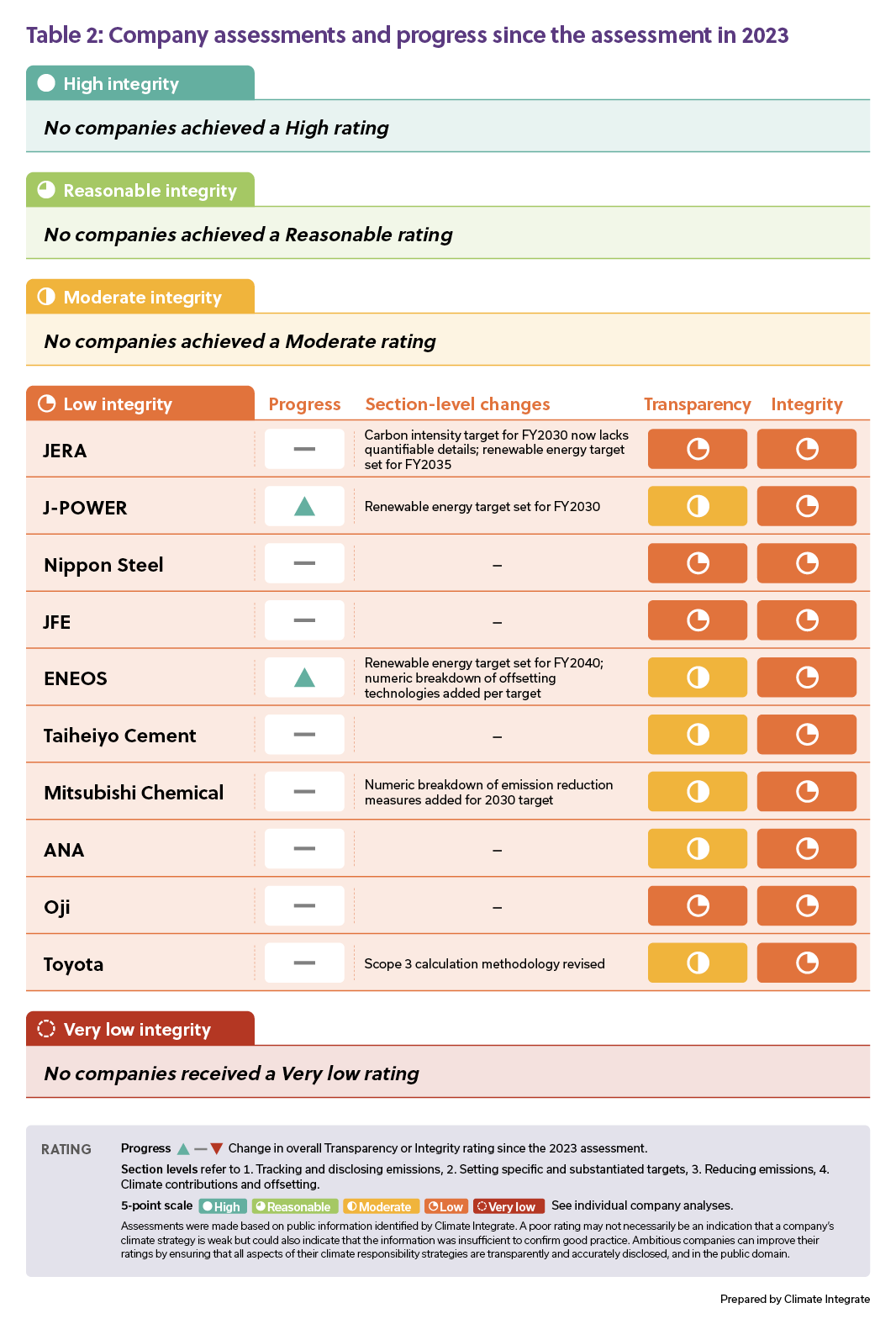
- All 10 companies maintain their net zero targets but lack progress in implementation.
- All 10 companies are still rated “low” in integrity.
- Scope 1 and 2 emission trends between FY2021 and FY2023 vary across companies.
- The pace of the transition to renewable electricity remains slow.
- Many companies rely heavily on emerging technologies to achieve targets.
- Companies’ targets and measures fall short of the efforts needed to limit global warming to 1.5°C.
- The 10 companies need to strengthen their targets and measures.
- The government has a vital role to play in unlocking the potential of corporate climate action.
Co-authors’ comments
Yuka Manabe, Corporate Analyst
While all assessed companies have set a net zero or carbon neutrality target by 2050, none of them have sufficiently transparent and credible decarbonization strategies in place. Their implementation could be improved through adopting cost-effective measures in line with 1.5°C-compatible benchmarks for the sector, with short, medium and long-term timelines and expected emission reductions for each measure.
Hiroaki Odawara, Program Director
For Japan’s overall decarbonization, the power sector must lead the way, achieving decarbonization well before 2050. However, it is concerning that the assessed power companies have set their net zero target year in 2050, relying primarily on new technologies such as ammonia- and hydrogen-firing and CCS, while falling short of the required level of renewable energy deployment. These new technologies remain expensive, and some have yet to prove their effectiveness in reducing emissions, which could undermine the achievement of Japan’s overall net zero target.
Kimiko Hirata, Executive Director
The 10 companies covered in this report represent leading companies within Japan’s most emission-intensive sectors. The fact that climate change strategies by major domestic emitters remain inadequate and ambiguous in many areas casts uncertainty over Japan’s overall net zero target. Recognizing this reality, it is crucial for the government to enhance the quality and credibility of corporate decarbonization strategies through various policy actions, including appropriate carbon pricing.
Ragini Sarmah, Researcher
The 10 companies assessed in this report are not only key domestic players but also bear significant climate responsibilities globally. Yet, critical gaps remain between their current efforts and the levels required. Insufficient progress in climate initiatives of such companies could also negatively impact other countries’ low carbon transition.